
If you live in New York, you already know: the closet is never enough.
Whether you’re in a Manhattan studio or a small Brooklyn apartment, closet space is often undersized compared to the actual volume of clothing you own. Winter brings heavy coats and bulky boots. Summer introduces an entirely different wardrobe. The space, however, stays the same.
These very small closet organization ideas are designed specifically for NYC apartments, where every inch needs to be used efficiently.
In short:
- Empty the closet completely and reset the space.
- Maximize vertical space.
- Control volume, not just shelves.
- Implement seasonal rotation.
- If the closet remains full, expand it strategically.
Very Small Closet Organization Ideas: Start With a Space Reset
Before applying any new system, you need to clearly understand what you’re working with. Most people try to organize without fully emptying the closet. That only leads to rearranging—not true optimization.
Empty everything and measure usable space
Remove everything from the closet, including items on upper shelves and in corners.
Then measure:
- The actual width of the hanging rod
- The depth of the shelves
- The height to the ceiling
- The open space beneath hanging clothes
In many NYC apartments, ceilings are high but the hanging rod is installed low. That often means there is unused vertical space.
Declutter before you organize
An organization system only works if the volume is realistic.
Divide your clothing into three categories:
- Items you wear frequently
- Seasonal items
- Items you haven’t worn in the past year
In many apartments under 800 sq ft, reducing volume is more effective than adding new organizers. If the closet remains overcrowded after sorting, the real issue isn’t layout—it’s volume.

Group items by frequency of use
Everyday clothing should stay at eye level. Rarely used or seasonal items can move to upper shelves.
Simple rule:
- Daily use = immediate access
- Weekly use = middle shelf
- Seasonal use = top shelf
This system reduces clutter without requiring additional investment.
Short Closet Ideas That Instantly Double Hanging Space
A narrow closet can be optimized vertically and by increasing hanging density.
Install a second hanging rod
If most of your clothing is short (T-shirts, shirts, jackets), you can add a secondary rod below the existing one. Check the minimum height clearance before installation to ensure garments won’t overlap.
Switch to slim hangers
Bulky hangers can reduce usable space by 5–10%.
Slim hangers:
- Allow more items on the same rod
- Reduce slipping
- Create a uniform alignment
This is one of the simplest small closet organization ideas you can implement immediately.
Use cascading or tiered hangers
These allow multiple items to hang vertically from a single hook.
Useful for:
- Pants
- Shirts
- Skirts
Avoid overloading them. Excess weight can bend or strain the rod.
Add hanging shelf organizers
Hanging shelf organizers turn vertical space into usable compartments.
They can hold:
- Folded T-shirts
- Jeans
- Bags
- Accessories
In many NYC rental apartments, permanent modifications aren’t allowed. Choose removable systems or tension rods instead.

Small Closet Organization Ideas That Actually Work in NYC Apartments
We’re not talking about Pinterest walk-in closets. We’re talking about narrow spaces—often under 30 inches wide.
Use shelf dividers for folded clothes
Stacks of folded T-shirts and sweaters tend to collapse when you pull out the bottom item. Shelf dividers solve exactly that problem.
How to use them correctly:
- Separate jeans from sweatshirts
- Limit each stack to 6–8 items
- Don’t fill the shelf completely; leave 1–2 inches of open space
Use stackable bins for the top shelf
The upper shelf becomes inefficient when items are placed directly on top of one another. By using stackable storage bins, you:
- Create clearly defined compartments
- Label items on the outside
- Remove a single bin without disturbing the rest
Add under-shelf baskets for wasted space
Most shelves have unused space underneath. Under-shelf baskets add an extra layer and are useful for scarves, belts, and small accessories. They don’t require permanent installation.
This is one of the most effective small closet organization ideas for narrow apartments.
Use over-the-door organizers for slim items
Over-the-door organizers work well for:
- Lightweight shoes
- Accessories
- Small personal items
They’re not suitable for heavy objects. The door should close smoothly without added pressure.

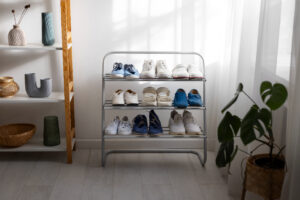
Shoe Organization Ideas for Very Small Closets
Shoes are one of the main causes of clutter, especially near the entry area. The issue: they take up floor space and reduce access to clothing.
Practical solutions:
- Narrow vertical shoe racks
- Stackable clear shoe boxes
- Seasonal rotation (don’t store sandals and winter boots at the same time)
- Keep only active pairs inside the closet
If you own 30+ pairs and have a 3-ft closet, the issue is clearly volume.
Clothing Organization Ideas for Apartments Under 800 sq ft
In NYC, many apartments are under 800 sq ft. The closet doesn’t just hold clothing—it compensates for the lack of additional storage areas. At this point, it’s not about shelves. It’s about controlling volume.
Build a capsule wardrobe system
This isn’t about aesthetic minimalism. It’s about efficiency.
Practical steps:
- Keep 5–7 core pieces per category
- Choose colors that work well together
- Eliminate duplicates (three nearly identical hoodies add no real value)
Benefits:
- Fewer items = faster access
- A less crowded closet
- Easier seasonal rotation
Organize by color for faster access
Grouping by color reduces search time.
Simple method:
- Light tones on the left
- Mid tones in the center
- Dark tones on the right
It’s not decorative. It’s functional. You immediately see what’s missing.
Vacuum bags — when they make sense
Vacuum bags reduce volume, but they can distort delicate items and aren’t ideal for everyday access.
They’re useful for blankets, very bulky pieces, and medium-term storage. They’re not a permanent solution for active clothing.
Closet Organization Hacks for Small Spaces
- Replace traditional hinged doors
In many small apartments, outward-swinging doors take up valuable front space and restrict access. Replacing them with sliding doors, fabric curtains, or even an open system frees up the area in front of the closet and makes daily use much smoother—especially in narrow rooms.
- Add dedicated lighting inside the closet
A poorly lit closet automatically feels smaller and more crowded. An LED strip mounted on the top shelf or a motion sensor light allows you to see what you have immediately, without digging through clothes. Better visibility makes organization easier to maintain.
- Use the full height up to the ceiling
Upper space is often left unused, even though it can hold labeled bins, luggage, or rarely used items. Taking advantage of this vertical area increases capacity without expanding the footprint.
- Maximize the space under hanging clothes
There is almost always unused space beneath the hanging rod. Low baskets, narrow bins, or modular drawers can turn that area into functional storage. This creates an additional layer without visually overwhelming the closet and helps keep categories clearly separated.
When a Closet Isn’t Enough — Managing Overflow in NYC
If you’ve applied every organization strategy and the closet is still full, the issue is no longer organization. It’s volume.
In New York, many apartments have a single closet. That one space has to support two seasons of clothing, shoes, luggage, occasional items, and sentimental pieces. At a certain point, physical capacity is simply exceeded.
Winter coats and bulky items
A single heavy coat can take up the space of four or five shirts. If you’re storing puffer jackets, wool coats, and tall boots at the same time, the closet becomes blocked.
Practical approach:
- Keep only the active season inside the closet
- Move the rest to a separate, organized space
- Rotate twice a year
Luggage and travel equipment
Suitcases often take up floor space or the top shelf. Most are used only a few times per year. If you need flexible access between trips, a 24/7 access storage unit can be useful.
Ask yourself:
- Does it really need to stay in the closet year-round?
- Can it be moved to a separate space?
A closet should remain functional for daily use. While some people use it for off-season clothing, that approach isn’t always the most efficient.
Collections and rarely used items
These may include formal dresses, suits, specialty footwear, or designer pieces. They’re worn occasionally but occupy permanent space. In a very small closet, occasional items can become a constant bottleneck.
Signs you’ve exceeded capacity
Four clear indicators:
- Clothes are pressed tightly against each other
- Hangers no longer slide freely
- The door won’t close without pressure
- Items no longer fit and are being stored elsewhere in the apartment where they don’t belong
Using a Storage Unit as an Extension of Your Closet in NYC
In most New York neighborhoods, residents use a self storage unit as an extension of their home space to manage volume in smaller apartments.
What fits in a 5×5 storage unit
A 5×5 unit is comparable in size to a small walk-in closet.
It can hold:
- Labeled boxes with off-season clothing
- 10–15 heavy coats
- Seasonal footwear
- Suitcases
It’s a practical extension for apartments without additional storage space. It’s also a strong option for those who need seasonal storage only or space for smaller miscellaneous items.
What fits in a 5×10 storage unit
A 5×10 unit can accommodate:
- The contents of a full closet
- Bulky items
- Small furniture pieces
- Rarely used equipment
For couples or families with children, this size provides meaningful flexibility. These two unit sizes are often ideal solutions for optimizing storage at home when daily overcrowding becomes uncomfortable.
Climate control for clothing
In NYC, humidity can affect textiles over time. If you’re using storage to optimize closet space, a climate-controlled storage unit is strongly recommended. It provides consistent protection regardless of the season or the items stored.
How to Prepare Your Closet Items for Self Storage
Moving items into self storage should be structured. If you pack randomly, you’ll simply create a disorganized closet in a different location.
- Clearly separate what goes and what stays
Don’t decide while packing. Determine in advance which items you won’t use in the coming months. Only those should go into storage.
- Group by category, not by empty space
Winter clothing together. Off-season shoes separately. Formal wear in its own box. Mixing categories makes seasonal rotation more difficult.
- Use uniform boxes and avoid overpacking
Identical boxes stack more securely. Fill them to about 80% capacity. Over-compressed textiles wrinkle easily and lose their shape.
- Label the sides, not just the top
When boxes are stacked, top labels aren’t visible. Side labels save time every time you access the unit.
- Leave an access aisle inside the unit
Don’t fill the space completely. Arrange boxes by category and maintain a small walkway. A properly organized 5×5 self storage unit can function like a secondary closet.
FAQ – Small Closet Organization in NYC
What is the best way to organize a very small closet?
Empty the space completely, reduce volume, then apply vertical organizers and seasonal rotation. Without controlling volume first, no system will work long term.
How do you organize a short closet?
Install a second hanging rod, switch to slim hangers, and add hanging organizers. The goal is to maximize vertical usage and effectively double hanging capacity.
How do New Yorkers store winter clothes?
Most rely on seasonal rotation. Heavy coats and winter boots are stored during warmer months and swapped back in the fall.
What size storage unit replaces a closet?
A 5×5 unit can replace a small walk-in closet. A 5×10 provides additional space for bulky items or for two people sharing storage.
Are storage units worth it in NYC?
For apartments with limited space, the monthly cost can be justified if it reduces clutter and improves daily functionality at home.