
Choosing which NYC borough to live in is one of the most important — and most personal — decisions you’ll make when moving to New York City.
The five boroughs — Manhattan, Brooklyn, Queens, The Bronx, and Staten Island — each offer a radically different lifestyle, price point, and pace of life. The right choice depends on your budget, your commute, your family situation, and what you actually want to do on a Tuesday night.
Take Our Free NYC Borough Quiz
This guide breaks down every borough’s pros, cons, average rent, and best-fit resident profile for 2026. Still not sure? Take our free quiz — answer 7 quick questions and we’ll match you with both the borough and the specific neighborhood where you belong.
Quick answer: Manhattan suits career-focused, high-budget renters. Brooklyn fits creatives and families. Queens offers the best value and diversity. The Bronx is the most affordable with a growing arts scene. Staten Island provides suburban calm with NYC proximity.
Before diving into the details, let our interactive quiz do the heavy lifting. Answer 7 questions about your commute habits, budget, lifestyle, and priorities — and we’ll recommend the right borough and specific neighborhood for you.
NYC Borough Quick Comparison (2026)
Here’s a side-by-side snapshot of all five boroughs. Rent figures reflect average monthly costs for a one-bedroom apartment in 2025.
| Borough | Avg. Rent/mo | Best For | Transit | Safety | Space |
|---|---|---|---|---|---|
| Manhattan | $4,000+ | Career, culture, dining | ★★★★★ | ★★★★ | ★★ |
| Brooklyn | ~$3,000 | Creatives, families, foodies | ★★★★ | ★★★ | ★★★ |
| Queens | ~$2,200 | Families, value seekers | ★★★ | ★★★★ | ★★★★ |
| The Bronx | ~$1,700 | Budget, creatives, students | ★★★ | ★★★ | ★★★★ |
| Staten Island | ~$1,500 | Families, suburban feel | ★★ | ★★★★★ | ★★★★★ |
Sources: University Living (2025)
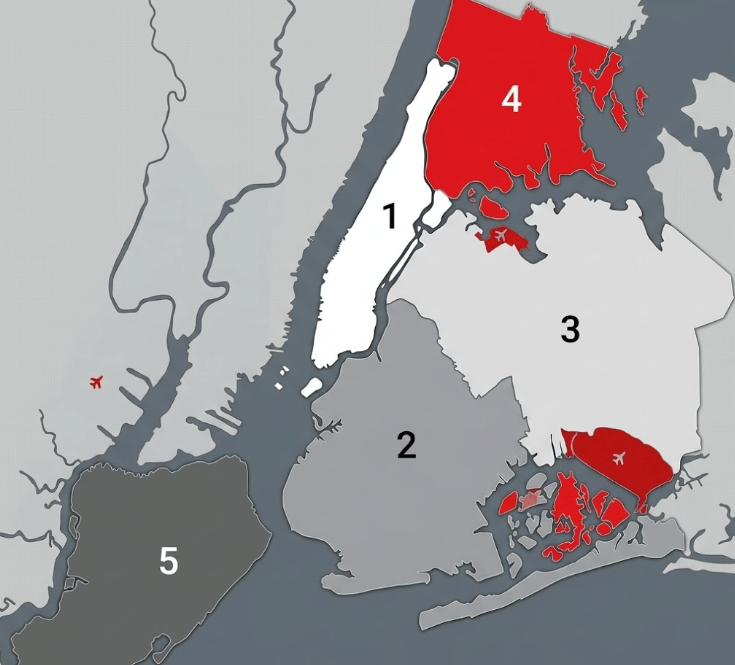
Manhattan – Best for Career-Driven, Culture-First Residents
Bottom line: Manhattan is the right borough if you prioritize career access, world-class dining, and seamless transit above all else — and have the budget to match. Average one-bedroom rent exceeds $4,000/month in 2025, making it the most expensive borough by a wide margin.
Why People Choose Manhattan
Manhattan is the undisputed business and cultural heart of New York City. Wall Street, major tech firms, media companies, and the city’s top universities — Columbia and NYU — are all here. If your job or your network is centered in Manhattan, living here cuts your commute and keeps you close to the action.
Transit is exceptional: virtually every subway line runs through the borough, and most destinations across the five boroughs are reachable within 30 minutes. Manhattan also has more Michelin-starred restaurants than any other borough, and world-class institutions like the Met, MoMA, and Carnegie Hall are steps from your door.
The Honest Downsides
- Average rent exceeds $4,000/month for a one-bedroom (2025)
- Apartments are notoriously small — expect to compromise heavily on square footage
- Noise, crowds, and constant stimulation wear many people down over time
- Green space is limited outside Central Park, which can feel crowded on weekends
Brooklyn – Best for Creatives, Families & Social Renters
Bottom line: Brooklyn is the most populous borough in NYC, home to approximately 2.7 million people. With average one-bedroom rent around $3,000/month in 2025, it offers lower costs than Manhattan while delivering a rich social and cultural life — making it the best fit for people who want a strong neighborhood identity and vibrant local scene.
Why People Choose Brooklyn
Brooklyn’s greatest strength is variety. Park Slope offers some of the best schools and green space in the city, with Prospect Park right at your doorstep. Williamsburg delivers rooftop bars, independent restaurants, and a creative energy that sets the tone for the rest of NYC. DUMBO combines cobblestone streets and Manhattan Bridge views with a growing tech and arts scene.
Brooklyn has over 700 arts and cultural institutions, and neighborhoods like Carroll Gardens and Cobble Hill offer a slower residential pace while still being deeply connected to the city.
The Honest Downsides
- Gentrification has pushed rents close to Manhattan levels in prime neighborhoods
- Some areas — Brownsville, East Flatbush, parts of Bushwick — have above-average crime rates
- Outer Brooklyn can feel disconnected without a direct express subway line
Queens – Best for Families, Commuters & Value Seekers
Bottom line: Queens is the second-largest borough and the most ethnically diverse, with 48% of residents being immigrants. Average rent sits around $2,200/month in 2025, offering significantly more space per dollar than Manhattan or Brooklyn. It’s the strongest choice for families and anyone who wants an authentic, community-driven neighborhood.
Why People Choose Queens
Queens wins on value and diversity. In Astoria you get waterfront parks, a globally acclaimed restaurant corridor, and a 25-minute subway ride to Midtown. Long Island City offers modern apartments and a 7-minute commute to Midtown — the shortest of any outer borough neighborhood. Forest Hills delivers tree-lined streets, Tudor Revival architecture, and top-rated schools.
Queens is also home to both JFK and LaGuardia airports, making it the natural choice for anyone who travels frequently for work.
The Honest Downsides
- Queens is large — commutes can become long and complicated if you live far from a subway hub
- Fewer transit options in some areas compared to Brooklyn and the Bronx
- Certain neighborhoods effectively require a car for everyday errands
The Bronx – Best for Budget-Conscious & Community-Minded Renters
Bottom line: The Bronx is the most affordable borough for renters, with average monthly rent around $1,700 in 2025 — less than half the cost of Manhattan. It’s the birthplace of hip-hop, home to the New York Yankees, and increasingly popular with young creatives priced out of Brooklyn.
Why People Choose The Bronx
The Bronx offers genuine affordability without sacrificing access to the rest of New York. The 4, 5, 6, B, and D subway lines connect the borough directly to Midtown in under 30 minutes from most neighborhoods. Riverdale is a leafy, suburban-feeling enclave with excellent schools and Hudson River views. Mott Haven has become the borough’s emerging arts district — a neighborhood with the energy of Williamsburg before the rents rose.
Beyond affordability, The Bronx punches well above its weight culturally. The Bronx Zoo, the New York Botanical Garden, Arthur Avenue’s legendary Italian food scene, and Yankee Stadium are all here.
The Honest Downsides
- Some neighborhoods have higher crime rates — research specific areas carefully before committing
- Fewer upscale dining and shopping options compared to Manhattan or Brooklyn
- The borough’s reputation can create unfair social perceptions that affect day-to-day life
Staten Island – Best for Families Wanting Suburban Calm
Bottom line: Staten Island is the least populous and most affordable borough, with average rent around $1,500/month in 2025. It’s also consistently ranked the safest borough in NYC — making it an excellent choice for families. The trade-off is transit: it’s only connected to the rest of the city via the Staten Island Ferry and the Staten Island Railway.
Why People Choose Staten Island
Staten Island gives you things that are genuinely rare in New York City: space, quiet, and a tight-knit community. The free Staten Island Ferry provides stunning views of the Statue of Liberty on every crossing. The borough has excellent beaches, the Snug Harbor Cultural Center & Botanical Garden, and Freshkills Park — the largest park developed in NYC since the 19th century, three times the size of Central Park.
For families, Staten Island offers some of the city’s best home ownership value. You can buy an actual house for what you’d pay for a small apartment in Manhattan or Brooklyn.
The Honest Downsides
- Only one subway line (SIR) which doesn’t connect to the MTA system — a car is strongly recommended
- Commuting to Manhattan means the ferry plus a subway: plan for 60–75+ minutes each way
- Far fewer restaurants, nightlife, and cultural venues than other boroughs
How to Choose the Right NYC Borough for You
No borough is objectively the best — the right one is whichever aligns with your actual life. Run through these four filters:
- Budget: Under $1,800/month? Focus on The Bronx, Queens, or Staten Island. Under $2,400/month? Most of Queens and parts of Brooklyn open up. $2,400+? All of Brooklyn and the lower end of Manhattan become accessible.
- Commute: If you commute to Midtown or Downtown Manhattan daily, proximity to express subway lines matters enormously. Manhattan, Long Island City, and central Brooklyn offer the shortest travel times.
- Lifestyle: Creative and social? Brooklyn or Manhattan. Outdoor and family-focused? Staten Island or Queens. Value-driven and community-oriented? Queens or The Bronx.
- Life stage: Single professional → Manhattan or Williamsburg. Young couple → Park Slope, Astoria, or LIC. Family with children → Forest Hills, Riverdale, Park Slope, or Staten Island.
Frequently Asked Questions
What is the cheapest NYC borough to live in?
Staten Island and The Bronx are the most affordable. Average one-bedroom rents in 2025 are approximately $1,500/month in Staten Island and $1,700/month in The Bronx — roughly one-third the cost of a comparable Manhattan apartment.
Which NYC borough is best for families?
Queens and Staten Island are generally considered the best boroughs for families. Queens offers excellent schools, diverse housing types including single-family homes, and strong community infrastructure. Staten Island adds the safety advantage — it’s consistently ranked the safest of the five boroughs — plus more outdoor space and better home ownership value.
Which borough has the best public transportation?
Manhattan has the most comprehensive transit network, with virtually every subway line running through it. Brooklyn and The Bronx also have strong coverage. Queens has solid transit near major hubs like Astoria and Long Island City, but connectivity drops further out. Staten Island has the weakest public transit — the SIR does not connect to the main MTA network.
Is Queens or Brooklyn better to live in?
It depends on your priorities. Brooklyn offers a more vibrant social scene and closer proximity to Manhattan — at a higher price. Queens delivers better value, more space, and greater cultural diversity, and is arguably the better borough for families. Both are strong choices; the right one comes down to your lifestyle and budget.
What is the safest borough in NYC?
Staten Island consistently ranks as the safest borough in NYC, with the highest concentration of first responders living there. Queens follows as the second-safest for most residential neighborhoods.
How much do I need to earn to live in Manhattan?
With average one-bedroom rent exceeding $4,000/month in 2025, most financial advisors recommend spending no more than 30% of gross income on housing. To comfortably afford a Manhattan one-bedroom, you’d typically need a gross annual income of at least $160,000.
Ready to Make Your Move? Moishe’s Self Storage Has You Covered
Whether you’re moving from out of state, downsizing into a Manhattan studio, or upgrading to a Queens townhouse, one thing is certain: you’ll need somewhere safe to store your belongings during the transition. Our team at Moishe’s Moving also specializes in stress-free NYC moves.
Moishe’s Self Storage offers over 20 different storage unit sizes across New York City, with facilities conveniently located near you. We serve individuals, students, and businesses — and whether you’re storing wine, furniture, art, or office inventory, we have a secure, affordable solution.
- Over 20 storage unit sizes available
- Locations across New York City
- Short-term and long-term storage options
- Climate-controlled units for sensitive items
Reserve your room, view our current specials, or contact us today — we’ll help make your NYC move as smooth as possible.